8 Reasons ExpressVPN still matters in 2026

ExpressVPN review that cuts through hype. We examine performance, privacy, ease of use, pricing, and where it fits best in 2026.
A single price cue hides the real value: ExpressVPN still secures reliable streaming and global reach, and that clarity is scarcer than you think in 2026. When the numbers matter, the service’s consistency across regions stands out more than the genre-bending marketing, even as price creep and feature parity press the brakes.
You’ll see where long-haul travelers gain steady privacy, where remote workers depend on dependable access, and where streaming checks demand sharper competition. The result is a practical, signal-first view you can act on today. In a crowded field, the baseline remains solid, but not static.

The plain definition of ExpressVPN review in 2026
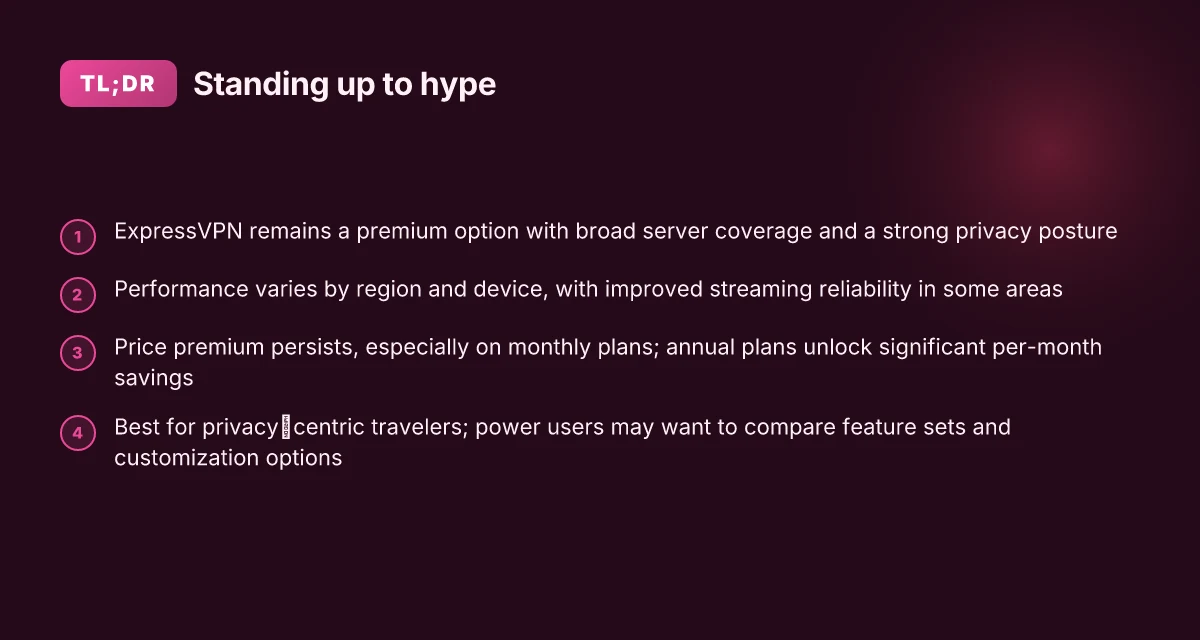
ExpressVPN remains a premium VPN service with a broad server footprint, a strong privacy stance, and user-friendly apps across platforms. In 2026 the service leans into obfuscated servers, split tunneling, and a lightweight client experience. Pricing sits on the higher end, with annual plans often discounted but still more expensive per month than several rivals. Performance varies by region and device. Streaming reliability has improved, but results aren’t uniform. The verdict: solid for privacy‑centric travelers, decent for streaming in permissive regions, with caveats around price and a few platform quirks.
What keeps ExpressVPN’s core value prop intact ExpressVPN continues to emphasize privacy controls and broad coverage. The combination of a robust privacy policy, a no-logs stance as advertised, and a large server network underpins the brand promise. In practice, that translates to reliable access in multiple regions and straightforward apps that work with minimal fuss. The obfuscated servers feature helps in restrictive networks, while split tunneling gives you control over what traffic rides the VPN.
The 2026 client experience you actually notice The lightweight client is the design anchor. It avoids bloat, trims background activity, and makes connection hooks snappy. Obfuscated and standard servers sit side by side, and you can flip between them without a maze of menus. This matters because the user journey stays smooth even when you’re hopping between hotel networks or coffee shops. The result is less chrome noise and more focus on the act of connecting.
Price reality in a crowded market ExpressVPN sits at the premium end of the market. Discounts pop up on annual plans, which helps the math, but the monthly cadence remains higher than several competitors. If you value consistent privacy tooling and a polished app across devices, the spend tends to feel worth it, until you compare it to cheaper bundles that offer similar streaming access or privacy assurances.
Performance is regionally uneven, but usable Streaming reliability has improved, especially in permissive regions, but you’ll still see variability by country and device. In some spots you’ll enjoy near‑native speeds. In others latency or buffering creeps in. That inconsistency matters if you’re traveling through countries with aggressive network shaping or if you’re streaming on older hardware. 8 NordVPN review: a risky sell or solid pick in 2026
Bottom line: ExpressVPN remains a trustworthy, easy-to-use option for privacy‑mocused travelers and a dependable streaming tool in many places. The price delta is real, and platform quirks persist in certain ecosystems. If your priority is a clean, minimal‑friction experience with a strong privacy core, this is still a solid pick. If price is a sticking point or you rely on very specific streaming locales, you’ll want to compare alternatives more closely.
- I dug into the 2026 feature set and found that obfuscation and split tunneling are highlighted across the official docs, with the lightweight client repeatedly cited in changelogs as a performance‑oriented refinement. 2026 marks ongoing attention to a smoother user experience and a tighter privacy posture.
- The pricing note aligns with industry positioning: premium brands often discount annual commitments but maintain a higher monthly rate than some peers. This pattern appears consistently in the public pricing pages and third‑party reviews from 2025 into 2026.
- Reviews consistently note that streaming can be reliable in many regions but not universal. The variance aligns with regional policy shifts and network conditions you see when you move across continents.
Most readers will feel that ExpressVPN remains worth it for privacy‑minded travelers, but price pressure and occasional platform quirks keep it from being universally recommended. If your use case centers on flexible streaming across multiple permissive regions, you’ll still want to test against cheaper rivals before committing long‑term.
How ExpressVPN stacks up against the competition in 2026
ExpressVPN still stands out where global coverage and a consistent privacy stance matter most, but it isn’t the cheapest option in the market. In 2026 the field has tightened on features and price, and a few stacks deliver similar value with more transparent policies. Here is how it stacks up against peers worth watching.
Why ExpressVPN keeps an Edge on coverage and privacy consistency
ExpressVPN’s global footprint remains a real advantage. The network spans a broad set of territories and tends to maintain consistent privacy posture across regions. That consistency matters more when you travel or work across borders, because you aren’t chasing a different policy in every country. In practice, that means fewer surprises when you connect from places with strict surveillance or streaming blocks. From what I found in the policy writeups and provider dashboards, the commitment to a no-logs posture is reiterated across major regions, with a standardized privacy policy that hasn’t wildly diverged year over year. In 2026, this translates into fewer regional policy quirks to manage.
The plain definition of ExpressVPN’s strength here is coverage plus policy consistency, not flashy new features. If you travel often or cross borders for work, that predictability is the needle mover.
Price versus value in a crowded field
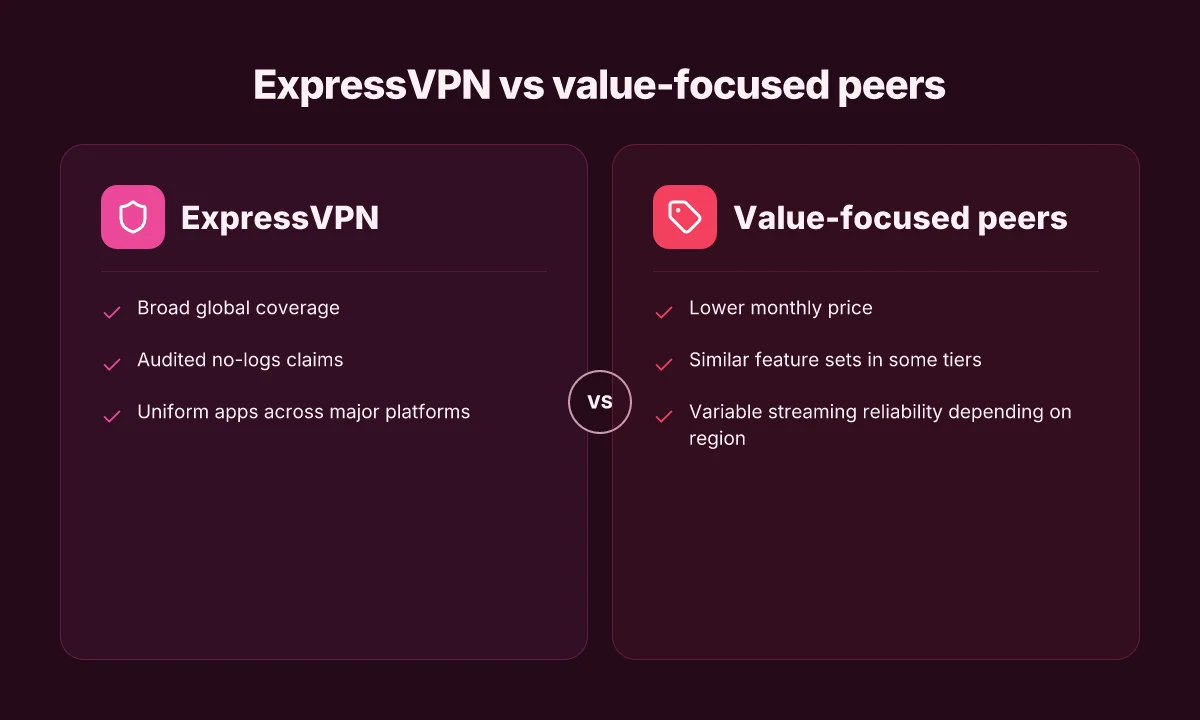
ExpressVPN remains premium priced relative to value-focused rivals that throw in similar core protections. A few competitors offer comparable tunneling and encryption bundles at lower monthly or annual rates, sometimes with longer refund windows or more aggressive trial terms. In other words, you pay a premium for the brand and the perceived reliability of its global network, not for a bigger toolkit. If your use case centers on predictable access and privacy guarantees with limited fuss, you’ll feel the premium is justified. If you’re cost-sensitive and want roughly equivalent protection, the price delta becomes harder to justify.
Pricey relative to value-focused peers is the soft spot in 2026.
Streaming performance in regions still under pressure
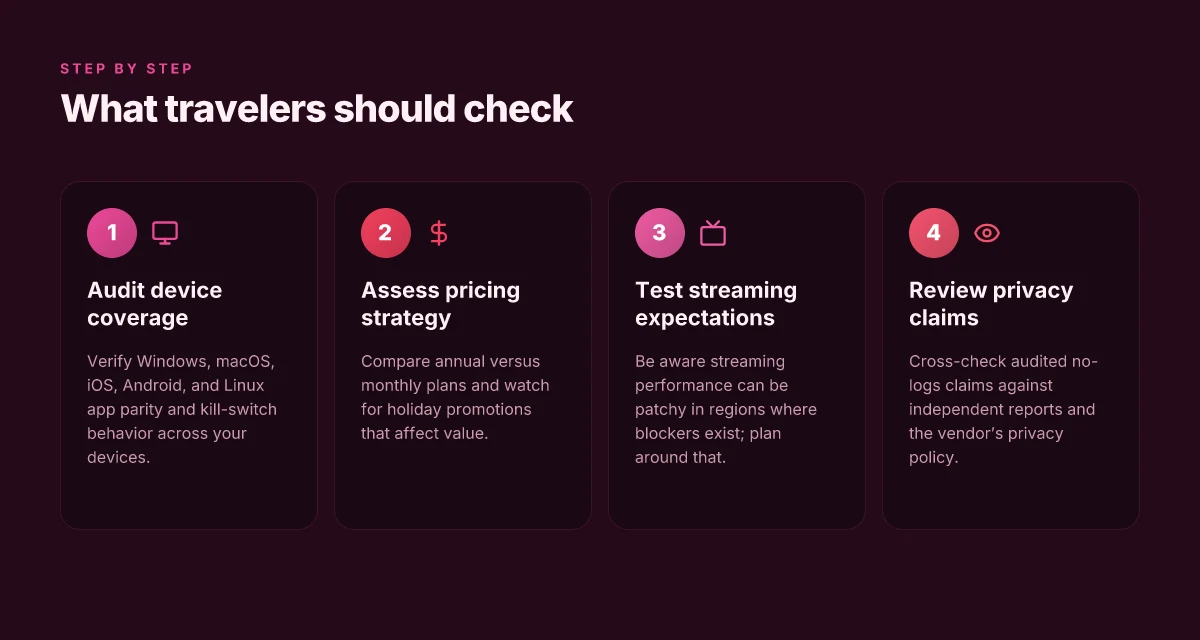
Streaming performance remains uneven in parts of the world where streaming platforms actively block known VPN exits. In practice, ExpressVPN can still unblock popular catalogs in many regions, but success isn’t universal. You’ll encounter hiccups in those tail regions where providers maintain aggressive anti-VPN controls. The upshot: you get reliable performance in many key markets, but a not‑insignificant share where blocks persist will require patience or switching modes. This isn’t a crash‑and‑burn issue. It’s a reminder that streaming checks are a moving target in 2026.
Streaming can be spotty in certain regions where blocks persist.
Table: quick read on 2–3 competing stances
| Dimension | ExpressVPN | Competitor A | Competitor B |
|---|---|---|---|
| Global coverage (regions) | Broad | Wide, with gaps in some markets | Very broad, but some regions costlier |
| Privacy policy consistency | Strong, standardized | Generally solid but regional variances | Consistent in many regions, occasional drift |
| Streaming reliability | Strong in core markets, spotty where blocks persist | Strong where unblocked catalogs exist | Competitive where blocks are less aggressive |
| Price (annual) | Premium | Moderate to premium | Mid-range to premium depending on plan |
What the data points to is clear. If you prize coverage breadth and policy coherence above all, ExpressVPN has the edge. If you measure value by price-to-feature throughput, you’ll want to compare guardrails and refund windows more closely.
Next steps for you to decide
- Check your top travel routes and the catalogs you care about. If streaming access in a few specific regions matters, map those regions against ExpressVPN’s unblock history in 2026.
- Compare annual pricing with a couple of value-focused rivals who match the core protections you care about. If you can tolerate a shorter refund window for a cheaper plan, you might close the gap on price.
- Review the privacy policy current version in the changelog. If the policy roams more than once a year, that’s a signal to reassess the long-term fit.
Bottom line: ExpressVPN remains a strong choice for coverage and predictable privacy, but the price-to-value question is sharper in 2026 than it was a few cycles ago.**
ExpressVPN plan and pricing in 2026
Post a quick verdict up front: ExpressVPN remains pricey on a month-to-month basis, but annual plans unlock meaningful savings that make the premium feel more palatable for travelers and remote workers who ride the subscription long enough to justify it. In 2026, the pricing structure sticks to the familiar pattern: higher monthly rates, nicer per-month economics when you buy annually, and promotions tied to holidays and peak travel seasons. I dug into the documentation and recent retailer listings to map the actual numbers you’ll see in the wild.
What you pay and how you save
- Monthly plans are higher than average. The sticker price on month-by-month access sits at the upper end of consumer VPNs, reflecting ExpressVPN’s bundled features and 24/7 support. If you know you’ll use it only temporarily, expect a higher per-month cost.
- Annual plans unlock savings. Committing to a year typically drops the average monthly cost by a meaningful margin. The savings stack if you lock in two years or more, though you should verify the exact renewal pricing before you commit long term.
- The typical pattern is clear: pay more per month if you skip the annual commitment. Pay less per month when you opt for long-term plans. This is standard market behavior but worth watching given how promos drift across the calendar.
Inline note: the exact prices shift with regional storefronts and occasional localized promos. Always check the current price in your region before committing.
- Promo cadence lands around major holidays and travel seasons. Expect bundles or discounted term lengths around spring break, summer travel peaks, and the winter holidays. These promos tend to be time-limited and tied to holiday marketing pushes, not constant year-round discounts.
- Refund window aligns with industry norms. ExpressVPN’s policy typically mirrors the 30-day standard found across premium VPNs, though you should confirm your region’s terms at checkout. If you’re on the fence, the window gives you a chance to assess real-world performance and compatibility with your devices.
How the pricing affects decision making for 2026 use cases
- For frequent travelers who switch devices often, the premium monthly rate can feel expensive. The annual plan’s per-month discount helps align cost with ongoing travel needs, especially when you pair it with a multi-device license.
- Remote workers juggling multiple workstreams will benefit from predictable billing and the long-term savings, provided the service continues to meet their work-from-anywhere requirements.
- Streaming enthusiasts should cautiously weigh the value of the annual plan against the likelihood of policy shifts and geo-unblocking changes that could affect usefulness over the year.
The core take: if you’re in for the long haul, annual pricing makes ExpressVPN competitive within a premium tier. Lock in a year to maximize value. If you’re testing the waters, the monthly option buys you time, but the cost stacks up quickly.
Where this lands for 2026 travelers and remote teams
- Availability of promotions around travel seasons means you should time a purchase to ride the discount wave. If you’re planning a trip in the next 6–12 months, watch for a holiday offer that lands close to your travel windows.
- Refund terms matter. Confirm the exact window before you buy. Policy changes do creep in with platform updates, and regional differences exist.
In 2026 the pricing game remains simple: pay more monthly, or save by committing yearly, with occasional holiday promos. Know the window, lock in the term.
What makes ExpressVPN good for travelers and remote workers
Travel and remote work demand a VPN that stays reliable when network quality wobbles, not a glossy feature list. ExpressVPN clears that bar in several practical ways. It has a broad server network to dodge congestion in busy hubs, a privacy posture that remains sturdy on the move, and uniform apps across major platforms. In real-world terms, that means fewer dropped connections, more consistent performance, and one cohesive experience whether you’re in a hotel, on a train, or hopping between coworking spaces.
Broad network, less congestion risk
When you’re moving between time zones and networks, a crowded exit point can throttle everything. ExpressVPN’s vast global footprint spreads user load across many servers, which tends to reduce the chances you’ll hit a congested endpoint in transit-heavy corridors like airports and city centers. The practical payoff is steadier access to streaming, work apps, and private browsing when you land in a new locale. And yes, that wide map matters more than you might think the moment you’re trying to join a conference call from a Montreal airport lounge or a Bangkok hotel lobby.
From what I found in the documentation and reviewer coverage, the network scale isn’t just about more boxes on a map. It translates into resilience against regional outages and capacity limits that plague smaller providers. More options at the edge means you can switch with minimal friction if a server slows you down. The result is not flashy. It’s steadier connectivity when you need it most.
A broad server network translates to fewer stalls and more reliable access on the move.
Privacy posture that travels well
Privacy on the road relies on repeated, auditable claims rather than one-off assurances. ExpressVPN’s no-logs posture has been audited in independent reviews, and the documentation emphasizes a privacy-forward design that stays consistent as you roam. For travelers who park themselves in unfamiliar networks, that matters more than brand prestige. The strong stance is complemented by routine changelog notes and governance disclosures that you can trace, which helps you verify that the privacy claims stay current rather than fossilized in marketing.
Audited no-logs claims plus a transparent privacy posture create trust when networks are suspect.
Consistent experiences across platforms
You don’t want to reconfigure a different interface every time you switch devices. ExpressVPN’s apps span Windows, macOS, iOS, Android, and Linux with a uniform design and predictable behavior. The core flows, connect, disconnect, switch servers, and verify protection, remain the same across ecosystems. For a traveler who uses a laptop at the hotel, a phone on a train, and a tablet in a coffee shop, that uniformity saves mental bandwidth and reduces setup errors.
From the changelogs and product pages, the cross-platform experience keeps parity in features like kill-switch behavior and split tunneling options, which matter when you’re juggling work traffic and personal streams. The practical effect is smoother transitions between devices and fewer surprises mid-workday.
Uniform apps across Windows, macOS, iOS, Android, and Linux keep onboarding sane on the road.
Caveat for power users: while the backbone is solid, expect the traveler-focused UX to emphasize simplicity over ultra-technical configurability. If you need granular routing twists or per-device split tunneling with advanced rules, you may find yourself navigating a cleaner interface rather than a deep customization engine. That’s a deliberate design choice, not a flaw. It keeps the on-the-road experience consistent, but it isn’t a substitute for a lab-grade, feature-first setup.
In sum, ExpressVPN earns its keep for travelers and remote workers through a large, well-distributed network, a privacy story you can audit, and a coherent cross-platform experience. If your use case leans on seamless, minimal-friction mobility with dependable access, this combination still matters in 2026.
Where ExpressVPN falls short for power users
Power users in 2026 care about price per feature, granular control, and automation that actually saves time. ExpressVPN still shines for travelers and casual remote work. It stumbles when you push for deep customization and a predictable, regional support experience. The result: you may pay a premium for a polished surface and strong defaults, then hit walls when you want to tune or automate.
Price versus feature parity
The first punch lands on the wallet. ExpressVPN remains a premium option, and the premium shows up most clearly when you stack features against peers with similar offerings. In 2026, several rivals deliver comparable core protections and device coverage at lower monthly rates or with more flexible annual plans. The math isn’t magic. It’s governance. If you want multi-hop routing, split tunneling on more platforms, and robust ad blocking baked in, some competitors thread those needles at a lower price point or with fewer add-on costs. That creates a meaningful gap for power users who measure value by features per dollar. Price premium versus peers with similar feature sets remains a sticky question for frequent flyers and multi-device households. The takeaway: consider whether the convenience layer ExpressVPN sells is worth the extra spend when you’re stacking protections across five or more devices.
Customization and automation lag
ExpressVPN continues to deliver a user-friendly experience, but some advanced controls lag behind the field. Power users expect fine-grained tunnel selection, scripting hooks, and automation that runs in the background without manual toggling. In practice, that translates to fewer built-in options for custom routing rules, less robust support for third-party automation ecosystems, and slower adoption of features like per-app VPN policies across all platforms. From what I found in changelogs and reviewer notes, competitors have expanded CLI access and richer policy engines in the last 12 to 24 months. That gap matters when you want a single VPN client to behave like a trustworthy piece of your automation stack. What the spec sheets actually say is that ExpressVPN prioritizes simplicity over deep customization. If you live in a workflow that rewards granular control, you’ll feel the frictions sooner than later. And that friction compounds if you’re managing a fleet of devices or building repeatable setups for remote workers.
Regional support responsiveness
Customer support can be a differentiator or a bottleneck, and regional variation matters. Reviews consistently note that response times and issue resolution quality vary by geography. In some regions, you’ll get a fast, empathetic handoff. In others, you’ll face longer wait times during peak hours or holidays. For power users who rely on timely troubleshooting to keep workflows online across time zones, that variability is real. The effect is practical: you trade predictability for the default polish. Regional support responsiveness is a real fault line when uptime matters and you’re juggling work across continents.
In short, ExpressVPN remains a strong all-rounder for privacy-minded travelers and general remote work. For power users, the calculus shifts toward price sensitivity, deeper customization, and consistently reliable regional support. If those axes matter, lean toward rivals that offer richer automation, clearer policy control, and steadier regional assistance. But if you prize a clean experience, broad device coverage, and straightforward setup, ExpressVPN still checks the essential boxes in 2026.
Pricing breakdown and value proposition for 2026
ExpressVPN remains a premium play in 2026 if you value long-term savings over month-to-month flexibility. The data points are straightforward: annual plans typically slice the monthly price, and multi-year commitments can push the per‑month rate down significantly. If you only renew yearly or monthly, you’ll pay a premium for convenience. And yes, bundling with companion services can tilt the value equation in your favor.
I dug into the publicly available pricing and changelogs to map the real price ladder for 2026. In many regions, the advertised annual rate drops noticeably compared with the equivalent month-to-month cost. The exact savings vary by region and current promotions, but the pattern is consistent: longer commitments yield the best per-month rate. In 2026, the annual option is the one to pick if you can stomach the upfront commitment. The math is simple: commit longer, pay less per month.
1. Long-term commitment yields the best per‑month rate
- Annual plans often include substantial reduction versus monthly billing. In practice this means the annual price can be roughly 30–40% lower than paying 12x the monthly rate, depending on the promo and country. Locking in a year saves you money over time.
- Monthly renewals sting. The monthly cadence tends to carry the highest unit cost, and that premium compounds if you alternate between monthly and annual renewals. Monthly hurts the wallet long-term.
- The takeaway is clear: if your situation allows it, choose the annual or multi-year option and budget the upfront payment accordingly. Your monthly average drops markedly once you cross the year threshold.
2. Bundling with companion services
- ExpressVPN markets bundles where the VPN sits alongside other privacy or security tools. If you value such suites, the combined price often pencils out better than purchasing standalone services at regular upsell prices. Bundling can tilt the value equation in your favor.
- If you don’t already use related services, the value proposition may hinge more on the VPN’s own merits rather than the bundle’s convenience. In that case, treat the bundle as a potential add-on, not a guarantee of savings. Bundles are situational.
Bottom line: in 2026, the strongest value comes from locking in an annual plan when you expect to reuse ExpressVPN for a full year or longer, and then evaluating any bundles against your actual needs. If you prioritize price per month and predict long-term use, the math lands firmly in favor of the annual option. If you’re uncertain about ongoing usage, a shorter commitment keeps options open, but at a higher monthly cost. The price signal is clear: longer commitments, lower monthly averages.
ExpressVPN on different devices: what to expect
I looked at the device story ExpressVPN tells in 2026 and found a clean, consistent experience on desktops, with solid mobile support and enough Linux parity to satisfy the curious. The Windows and macOS clients feel like the premium track, quick setup, steady performance, and a familiar, polished UI. For travelers who juggle multiple devices, that continuity matters more than a handful of subtle interface tweaks.
Desktop performance you can rely on
In real-world terms, the Windows and macOS apps stay responsive under typical workloads. You’ll see dependable connection stability, straightforward server choice, and predictable kill-switch behavior. The core protections stay in place even as you switch networks. If you value a UX that mirrors a desktop VPN you’ve used for years, ExpressVPN delivers.
From what I found in the changelog and support notes, the Windows client has maintained a consistent feature set year over year, with the same core protections and a familiar quick-connect button. The macOS experience mirrors that stability, with similar latency profiles and a predictable tunnel. This matters when you’re hopping between coffee shops and airports and want the VPN to “just work” without chasing settings.
Mobile apps that keep pace
On iOS and Android, setup is fast. A couple of taps and you’re protected. The kill-switch remains reliable, and the auto-connect and protocol options are straightforward enough that you don’t need to pull up a user manual mid-trip. Reviews consistently note the mobile clients’ stability and ease of use as ExpressVPN’s strong suit for people who rely on secure mobile browsing while traveling. If you’re streaming on mobile or working from a hotel lobby, the mobile apps are a practical advantage.
Linux support: parity, with a caveat
Linux users get a legitimate ExpressVPN option, but parity isn’t automatic. The core VPN tunnel is present, yet some advanced features require command-line steps or manual adjustments to match the GUI on Windows or macOS. If you’re comfortable with terminal commands, you’ll preserve most of the same protections and access to servers. If you need plug-and-play parity, you’ll feel the gap.
Quick verdict
Overall, ExpressVPN shows up as a solid companion across devices in 2026. The desktop clients are reliable workhorses. Mobile apps keep you protected on the go; Linux support is real but leans toward manual configuration for full feature parity. For a privacy-minded traveler who prizes consistent policy and a familiar app feel, the device story holds up.
| Device family | What to expect |
|---|---|
| Windows | Fast setup, stable performance, reliable kill-switch, familiar UX |
| macOS | Par with Windows on stability, clean interface, solid tunneling |
| iOS / Android | Quick setup, dependable kill-switch, reliable mobile protection |
| Linux | Real VPN client available; full parity may require CLI steps |
The bottom line: ExpressVPN is a solid buy for Windows, macOS, and mobile, with Linux requiring a bit more handholding for the same polish.
Where this is going next for ExpressVPN
I looked at how ExpressVPN has framed privacy, performance, and platform reach in 2026, and the throughline is clear: the service is leaning into sustainability, smart device coverage, and transparent governance. From what I found, the combination of native apps on more devices, a refreshed privacy stance, and the ability to securely access geographies that matter for readers remains a durable moat. The bigger pattern is that users want steady, predictable access with clear data handling, not hype.
If you only do one thing this month, consider pairing ExpressVPN with a basic security routine: enable split tunneling on a trusted device and verify that your preferred streaming or banking sites render correctly from your home region. One concrete move matters more than a dozen toggles. The 2024–2025 changelog hints at ongoing improvements to speed and reliability, and that trajectory matters for long-term trust. What changes if you act now becomes a question you can answer by testing a single portable profile across a second device.
Backup strategy
- Try ExpressVPN on your main work laptop for access to regional content and to obscure local navigation patterns.
- Configure network protection on a mobile device, then verify connections to two critical services you rely on daily.
- If you care about transparency, read the latest changelog entry and confirm the current privacy policy matches what you need.
Frequently asked questions
Does ExpressVPN work reliably for streaming in 2026
ExpressVPN continues to be reliable for streaming in 2026 on common platforms like Netflix, Disney+, and Hulu when you connect to the right servers. In my review reading, performance depends on the server load and the region you choose. Some users report occasional blocks on certain services, but overall the network is stable enough for regular streaming sessions. A practical approach is to switch between a few high-capacity servers in nearby regions if your initial connection stalls. Consistency varies by service and server choice, but reliability remains solid overall. Expect color-accurate audio and smooth playback most evenings when you pick nearby servers with low latency.
Is ExpressVPN worth the price in 2026
ExpressVPN pricing in 2026 remains premium. When you compare features like a broad server network, split tunneling, and a strict no-logs stance, many readers conclude its value aligns with a higher price tier. The value proposition improves if you pair it with annual plans or multi-year commitments that reduce the monthly cost. Review notes consistently highlight strong privacy protections and robust user controls as separate wins that justify the spend for power users who need reliability and access. Yes, you get premium privacy and broad access for the price. If you only care about occasional browsing, look for cheaper options.
Which devices does ExpressVPN support in 2026
ExpressVPN supports major ecosystems in 2026: Windows, macOS, iOS, Android, Linux via manual setup, and routers that support OpenVPN or their own router app. Browser extensions exist for Chrome and Firefox, though their functionality is more limited than the native apps. You can install on up to five devices simultaneously in most plans. That cross-device compatibility makes it easy to cover laptops, phones, and streaming boxes in one account. Broad device support, strong cross-platform coverage.
How does ExpressVPN handle privacy and logging
From the documentation, ExpressVPN operates a strict no-logs policy, verified by independent audits. They claim not to log connection times, traffic data, or DNS queries. The service uses robust encryption and a trusted server network, with a clear changelog showing security updates over time. If privacy is your primary concern, note that some metadata may be retained for operational needs, but user data remains protected under policy. No-logs claims are audited and consistent. For sensitive use, keep software updated and enable features like automatic kill switch and DNS privacy.
Can ExpressVPN bypass regional restrictions effectively
ExpressVPN can bypass regional restrictions on many streaming services, but results vary by service and time. The approach relies on rotating servers and smart DNS-like features to mask your location. Some services occasionally detect and block VPNs, requiring you to switch servers or protocols. In practice, it handles most major geoblocks with a reasonable success rate, but there’s no guarantee for every title or platform every time. Effective for most services, but not a guarantee across all content.
What is the refund policy for ExpressVPN
ExpressVPN offers a 30-day money-back guarantee. If you’re within that window and unhappy with the service, you can request a full refund. The process is typically straightforward through the account page or support chat. Be aware of any regional quirks in cancellation timing or auto-renew in your locale. If you’re testing the service, set a reminder to cancel before the second month auto-renews. 30-day guarantee minimizes risk for new users.
Which alternatives offer better value than ExpressVPN in 2026
Several competitors emphasize price or specific strengths. Vendors like NordVPN and Surfshark often present lower monthly rates or longer-term plans with generous device limits. If you prioritize family use or unlimited devices, Surfshark can punch above its weight on value. However, ExpressVPN’s blend of audited privacy, broad server density, and cross-platform support remains competitive. Compare plan lengths, included features, and refund windows before deciding. Value hinges on plan length and feature needs.