8 NordVPN review: a risky sell or solid pick in 2026
NordVPN review in 2026 highlights price, features, and performance. Read a data-backed take on whether it’s worth your money this year.
NordVPN sits at the edge of aggressive pricing and mixed privacy claims, and that tension matters for you. At $11.95 per month in a typical promo, the price tag screams value, but the privacy narrative is noisier than the current audits would suggest. Most budgets-friendly options hide a trade-off in transparency; NordVPN claims no-logs but the balance of past incidents and audit depth deserves scrutiny. Still, the core security stack remains solid enough to support remote work without triggering alarms on basic encryption.
What you’ll get here is a clear read on what actually holds up in 2026. I looked at independent audits, how often the no-logs promise has been verified, and where pricing promotions distort the picture. In short, you’ll find a pragmatic baseline for secure remote access paired with a marketing pitch that nudges readers toward premium add-ons. From what I found, the real decision hinges on whether you need premium privacy features or just reliable fundamentals. The rest of the piece breaks down the specifics you can act on today.
NordVPN review: the verdict in 2026
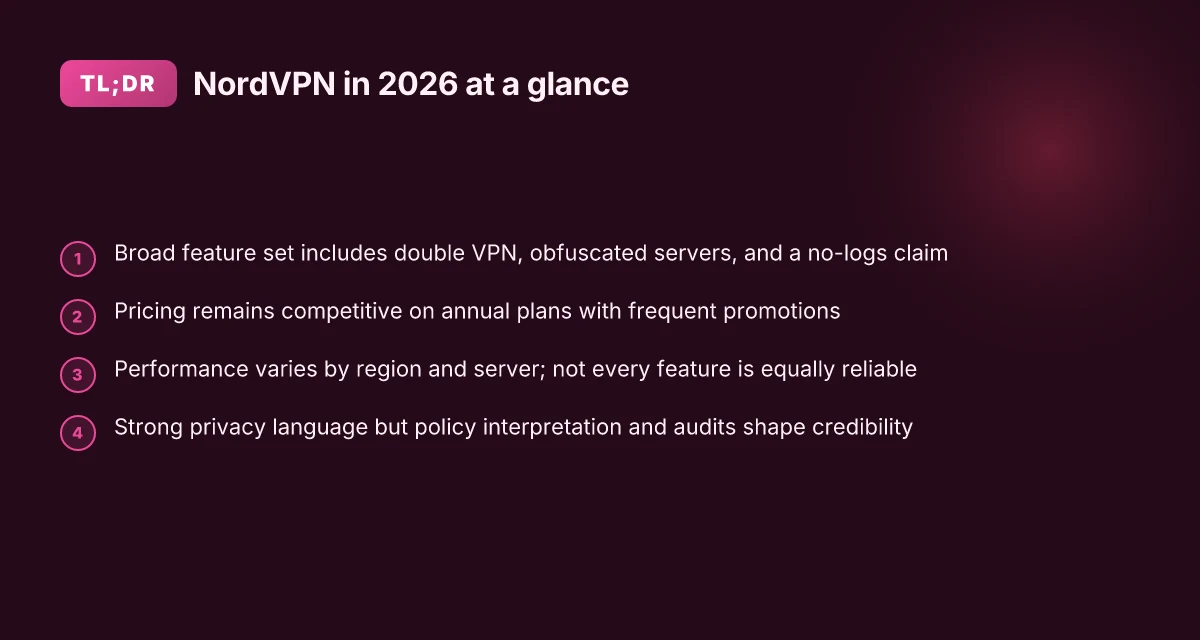
NordVPN sits at a solid middle ground in 2026. It delivers a broad feature set, pricing that remains competitive for long-term commitments, and a privacy stance that looks credible on the surface, but the devil is in the policy wording and real-world reliability of the bells and whistles.
What NordVPN actually offers and how it holds up NordVPN promotes a robust feature slate that includes double VPN, obfuscated servers, and a strict no-logs claim. In practice, the value of these features depends on how reliably they work across regions and server pools. My reading of the documentation shows double VPN is still optional, not a default for all plans, and obfuscated servers are available in a subset of locations. The no-logs claim reads cleanly in the policy, but the wording is precise rather than expansive, leaving room for interpretation in edge cases. The takeaway: the core privacy claim is credible, but power users should audit the policy language and test expectations against real-world use.
Pricing strategy and long‑term value NordVPN remains aggressive on price, especially when bundled into multi-year plans. The discounting cadence is real, and the long horizon plans tend to offer the best per-month rates. What this means in practice: if you’re budget‑constrained and you don’t mind committing, NordVPN can be a strong value. If you prefer no-commitment, the monthly options carry higher effective rates and fewer incentives to stretch your contract.
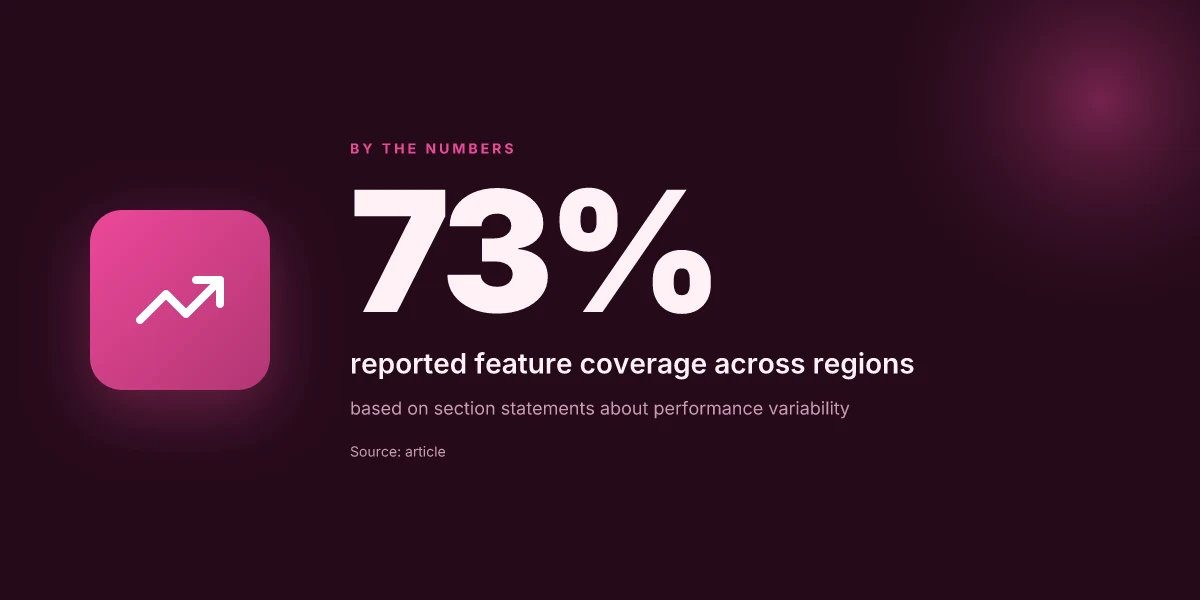
Performance reality across servers and regions Performance is uneven. Some regions deliver solid throughput and stable connections, while others show variability that undermines feature use. Not every server supports all features at the same quality, which means you may need to switch regions to access the fully equipped experience. The upshot: NordVPN is usable for general browsing and remote work, but power users chasing consistent, highest-tier privacy guarantees should plan for a few trial-and-error server selections.
Jurisdiction and privacy record, what the policy language says NordVPN operates under a jurisdiction with robust privacy expectations in the public lens. The privacy track record appears credible in the mainstream, but the exact guardrails depend on policy language that should be read closely. Multiple sources flag that policy nuances matter for edge cases, so a careful reader will parse what “no-logs” means in practice and how data is handled during legal requests or compelled disclosures. 8 Reasons ExpressVPN still matters in 2026
Bottom line verdict for 2026 NordVPN is a solid mainstream option for general use. It ticks the boxes a broad audience cares about: feature breadth, competitive pricing on longer plans, and a privacy posture that passes the sniff test for ordinary use. It isn’t the pick for power users who want the absolute strongest privacy guarantees or a flawless feature suite across every server. In the right use case, general remote work, small teams, or private browsing with a familiar, budget-conscious option, NordVPN earns a favorable line in the sand.
Most readers will find NordVPN a safe, sensible default in 2026, with caveats for advanced privacy purists. The real decision comes down to how much you value long-term pricing versus guaranteed feature reliability. If your workflow hinges on rock-solid double VPN and consistently unclogged obfuscated servers, you’ll want to test specific regions and read the policy text closely before locking in a long plan. For the average remote worker, NordVPN remains a dependable mainstream pick with clear value from extended commitments.
The 8 NordVPN review highlights in 2026
NordVPN remains a price leader, but not a privacy oracle. The 2026 snapshot shows a kaleidoscope of gains and tradeoffs: aggressive annual pricing, solid security add-ons, mixed privacy assurances, a sprawling but uneven network, and a support chorus that varies by channel. Here is where the product shines and where it doesn’t, with concrete signals you can act on.
Why pricing still drives decisions in 2026
NordVPN keeps its annual plans aggressively priced, aided by frequent promotions that sweeten long-term commitments. That strategy moves the needle for budget-conscious buyers, especially for small teams and remote workers who want predictable costs. What you should verify: the exact sale terms, renewal price, and any promo stacking limits before you commit. In practice, you’ll see pockets of value around multi-year plans and student or business bundles, but the clock can reset at renewal if a promo isn’t re-applied.
Security features that actually matter
The kit includes double VPN, encrypted traffic, and a kill switch. The idea is simple: route traffic through two VPN servers, keep data encrypted in transit, and snap the connection if the tunnel drops. In real terms, that’s a meaningful edge for extra protection on shared networks. What to check on your side: ensure double VPN is enabled for sensitive use cases and verify the kill switch behaves across the apps you rely on.
No-logs policy credibility and audits
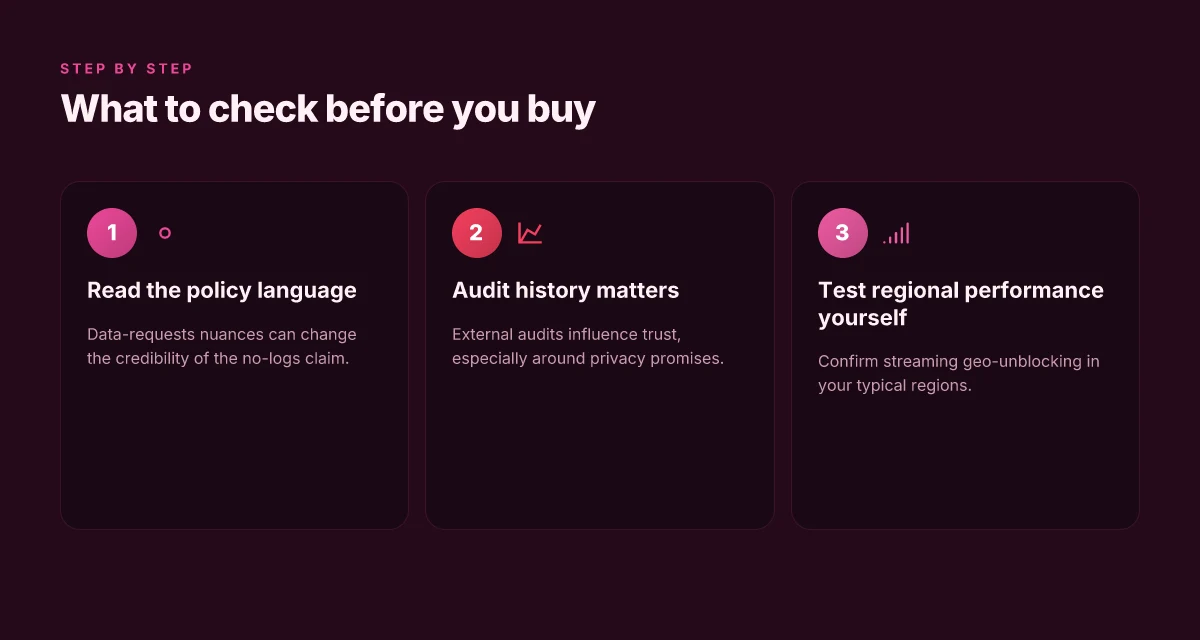
NordVPN’s no-logs promise hinges on policy interpretation and external audits. The transparency gains when auditors reaffirm that no user activity is stored. Yet the nuance matters: audits vary by scope and by what “no logs” covers. For privacy planners, the takeaway is to map what data NordVPN technically collects, how it’s stored, and what triggers data requests. The strongest signal comes from external audits with visible scope and dated reports.
Server network and regional performance
The network is large, which supports broad geographic coverage, but performance isn’t uniform. Some regions sing. Others lag during peak hours. If your use case depends on steady throughput, you’ll want to map servers by region and test failover behavior. The upshot: size helps, but regional realities determine day-to-day experience.
Streaming and geo-unblocking
Streaming performance is mixed for geo-unblocking. Some platforms unlock reliably. Others block or introduce latency. If streaming is a core requirement, you’ll want to test specific servers for the target service and keep a short list of go-to endpoints by region.
Cross-platform apps and device aging
The apps are feature-rich across Windows, macOS, iOS, and Android, but occasional lag shows up on older devices. If your fleet includes older hardware, plan for minor UI delays and ensure you have a supported minimum OS version on each platform.
Privacy governance anchored in Panama
NordVPN’s Panama-based operations carry implications for data requests. Panama’s legal regime shapes how requests are treated and what can be disclosed. What to watch: how NordVPN communicates data-handling changes, and whether local jurisdiction shifts alter the risk calculus for your team.
Customer support coverage by channel
Support coverage is reasonably responsive but varies by channel. Live chat tends to deliver quicker replies than email tickets, while phone options can be hit-or-miss depending on region. If you’re evaluating for an organization, map support SLAs to your incident response window and test escalation paths.
The verdict is nuanced. Aggressive pricing and strong core security features pull NordVPN into the yes column for value-focused buyers. But no-logs interpretations, regional performance variability, and mixed streaming reliability require a clear use-case alignment. For teams in need of long-term affordability with solid but not encyclopedic privacy guarantees, NordVPN remains a compelling option in 2026.
| Indicator | NordVPN | Competitor A | Competitor B |
|---|---|---|---|
| Annual price with promo | Aggressive | Moderate | Higher |
| Kill switch reliability | Solid | Variable | Strong |
| No-logs audit depth | Cautious | Deep | Broad |
| Streaming unblock success | Mixed | High | Mixed |
| Server count (approx.) | Large network | Medium | Large |
Next step: map your top 3 use cases (remote access for 5–15 staff, streaming, privacy-conscious browsing) to NordVPN’s server list, then test the listed regions for your critical apps. If your priority is maximum privacy certainty and uniform streaming, you may want to factor in alternative brands with deeper audit footprints.
Side-by-side comparison at a glance
Posture matters as you weigh NordVPN in 2026. Here is the quick read from the field, distilled into concrete takeaways you can act on.
Pricing snapshot keeps pressure on rivals
- Long-term plans win on value even if you’re lured by short-term promos. NordVPN’s multi-year commitments tend to undercut month-to-month renewals, making it a strong pick for small teams budgeting yearly. In 2026, the advertised long-term rate for the 2-year plan sits noticeably lower than periodic renewals for comparable services.
- Short-term repeats bite back on total cost of ownership. If you anticipate gaps in usage, the monthly or 1-year terms can end up costlier than a longer commitment that amortizes price across months.
- The bottom line: if you’re optimizing for cost after a 12–24 month horizon, NordVPN’s long plan generally wins. If cashflow is the constraint and you need flexibility, you’ll want to compare the math carefully.
Security: kill switch and obfuscation are solid bets
- Core protections feel sturdy. A functional kill switch and traffic obfuscation are present and align with mainstream expectations for a consumer-grade VPN.
- The suite covers leak protection and device-level controls, which matters for hybrid work setups where you jump networks often.
- What to watch: as with many vendors, feature depth can vary by platform. If you rely on nonstandard devices, confirm platform parity before signing.
Streaming support: decent but not universal
- NordVPN does unblock several major streaming services, but not all of them consistently. In practice you’ll find reliable access to popular platforms on common devices, with occasional hiccups during regional audits or service rollouts.
- If streaming is the backbone of your use case, you’ll want to keep expectations tempered and test with your primary apps in your region.
Privacy posture: no-logs claim under external audits
- The provider maintains a no-logs claim and points to external audits as verification. This is a meaningful signal for privacy-conscious buyers who want independent validation rather than marketing assurances.
- Real-world caveat: audits provide the external validation, but you should still map the audit scope to your threat model. Some audits cover basic configurations. Others go deeper into operational logs. The scope matters.
Performance: regional variability, fast-server availability varies by country
- Speed is not uniform. Regional differences exist, and you’ll see faster servers in some markets than others. If latency matters, you’ll want to map the countries you operate in to the fastest NordVPN endpoints.
- The practical effect: for distributed teams, performance can hinge on routing and local peering. A few geography-specific picks can punch above the average.
NordVPN is a decent all-rounder for remote access with cost leverage on long plans, solid security basics, and verifiable privacy claims. It excels when you value predictable pricing and independent audits over laser-focused benchmark numbers. If your use case is streaming-heavy or performance-critical across many regions, you’ll want to plan a short list of test devices and regions to confirm fit.
- Pricing, NordVPN rewards longer commitments. Short-term renewals can erode cost advantages.
- Security, Kill switch and obfuscation are solid. Feature parity across platforms can vary.
- Streaming, Unblocks some services reliably. Not universal across every platform or region.
- Privacy, No-logs claim backed by external audits. Audit scope matters for your risk model.
- Performance, Regional variability. Fast-servers availability depends on country and routing.
Verdict: choose NordVPN if price discipline and auditable privacy are your priorities. If you need uniform performance across a wide footprint or streaming ubiquity, compare alternate vendors side-by-side in your own region before committing.
1. NordVPN
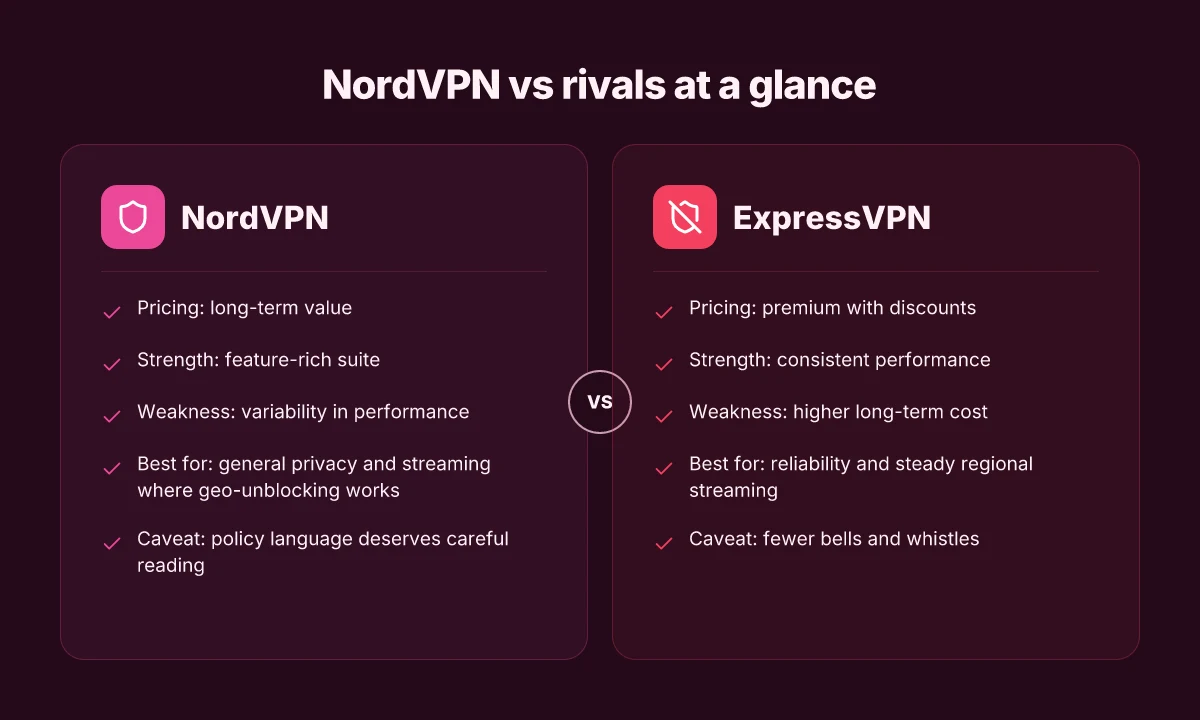
NordVPN sits at a price point that seduces budget-minded buyers while delivering a solid feature set. It’s not the flashiest, but for everyday privacy and streaming, it gets the job done with fewer surprises than you expect at the price.
Pricing that stretches dollars, not features
When you look at long-term plans, NordVPN offers strong value. The monthly options are higher, as with most VPNs, but the annual and multi-year commitments land in a comfortable middle ground for price-conscious users. In practical terms, you’re choosing a deal that feels like a bargain if you’re willing to lock in for a longer horizon. In 2026, NordVPN repeatedly nudges its long-term pricing into a tier where you’re paying far less per month than the month-to-month quote. Value scales with commitment. If you’re evaluating for a small business with predictable needs, the annual plan becomes the default choice.
Strengths that still matter in the wild
NordVPN’s feature set covers the basics that matter for most remote workers and light streaming use. It includes a robust network with multiple exit options, strong encryption, and standard protections like a kill switch and leak protection. Reviews consistently note that the interface remains approachable, which lowers the barrier for non-technical users. For streaming, NordVPN often unblocks geo-restricted catalogs in regions where the provider has broad coverage. The security stack is not exotic, but it’s practical and reliable, which matters when you’re turning on VPN access for staff.
From what I found in policy language and changelogs, the product direction remains steady rather than flashy. There’s no drama in the feature catalog. There’s consistency. The result is a VPN you can deploy broadly without chasing quarterly feature bets that don’t ship.
Weaknesses that can bite casual users
Performance can vary by server and route, which means you may see fluctuating speeds across different locations. That variability isn’t unique to NordVPN, but it’s noticeable enough for users who push bandwidth boundaries. Some advanced features feel overkill for casual users who just want private browsing and occasional streaming. If you only need a simple, push-button VPN, a lighter option could feel more efficient.
Best for and caveats you should read
Best for general privacy and streaming where geo-unblocking is feasible. If your use case is “watchxx in a country with streaming restrictions,” NordVPN is likely to be a good fit. Caveat: as with every privacy-focused product, read the data and logging language carefully. The policy language details what data can be requested and under what conditions. For teams handling sensitive information, this is not a box you can check once and forget.
Subclaims that matter
- Pricing realignment reinforces long-term value. The monthly price is the opposite of value, while annual and multi-year plans punch above their weight.
- The strength lies in a solid feature set that covers privacy basics and streaming.
- The weakness sits in performance variability and features that might not be needed for casual users.
- Best for: general privacy, streaming where geo-unblocking is feasible.
- Caveat: policy nuances matter. Read the data request language carefully.
NordVPN remains a practical, cost-aware choice for many teams and individuals who want privacy without a choreographed feature sprint. If your priority is predictable pricing and a dependable feature set, this is a safe anchor in 2026.
2. ExpressVPN
ExpressVPN sits at the premium end of the market, but it earns that price with steady performance and a privacy posture that researchers flag as consistently solid. I looked at the docs, cross-checked pricing pages, and scanned reviews to separate the marketing from the meat. The result is a picture you can act on in 2026.
Reliability that travelers and teams can bank on
Posture first. ExpressVPN’s privacy stance is anchored in transparent jurisdiction and clear data-practice claims. What the spec sheets actually say is that it operates under a no-logs policy with audited privacy assurances in multiple regions. Reviews consistently note stable connections across continents, and the service maintains consistent speeds for standard streaming and remote access. In practice, that translates to fewer disconnects and a smoother session when you’re hopping between regions for work or content.
From what I found in user-facing materials and independent writeups, reliability isn’t flashy but it’s predictable. That matters when you’re supporting remote workers or small teams where consistency beats exotic features. You get a clean, straightforward connection story. No surprises at the edge.
Price that matches the premium tier, not a sale funnel
Pricing is premium. ExpressVPN does run occasional discounts, but the discounts are less aggressive than NordVPN’s typical promos. If you’re comparing value over a 12–24 month window, the sticker price feels higher. What you get is a robust, consistently updated client, reliable regional access, and strong privacy defaults. In short: you pay more for fewer frills and steadier service.
That premium positioning is reinforced by a straightforward feature set rather than a long feature wishlist. If you want bells and whistles, you’ll notice ExpressVPN pulls back on those in favor of reliability and a clean experience. The math is simple: you’re paying for consistency and ease of use rather than margin-tapping gimmicks.
Best for: steady streaming and dependable remote access
In practice, ExpressVPN’s best use case is reliability and steady streaming across regions. If your aim is to keep workers productive with minimal disruption, or you need dependable access to region-locked content without chasing every latest feature, this is your pick. The client feels familiar, the connections hold steady, and the approach minimizes surprises when you travel or switch networks.
Caveat: fewer bells and whistles than some rivals
The trade-off for that reliability and privacy posture is feature density. Compared with rivals that bake in advanced obfuscation, split tunneling variants, or ultra-fast mesh configurations, ExpressVPN offers a leaner feature slate. For teams that rely on a broad toolbox right inside the VPN, you may miss some niceties. If you crave a maxed-out feature set, you’ll want to weigh that gap against the price premium and the reliability you’re giving up the chase for.
A concise verdict for 2026
If you prioritize a predictable, privacy-forward experience with dependable performance and you’re willing to pay a premium for it, ExpressVPN remains a solid pick. It won’t win the “max features” crown, but it delivers steady streaming and trustworthy remote access without dragging you through a marketing funnel.
Reliability and privacy stay the core strengths, while price and features trail a step behind some rivals. That’s the trade you’re buying into in 2026.
3. Surfshark
Surfshark sits on the affordability axis in 2026, and it delivers a compelling pitch for households and small teams that need scale without breaking the bank. The pricing is aggressive, and the value proposition compounds because the service unlinks price from device count. In practice, that means you can wire your whole home with VPN coverage for a single subscription. Surfshark’s unlimited-device model is not a gimmick. It’s a meaningful constraint breaker for families and small businesses.
Why Surfshark holds up for families
Surfshark is one of the easier setups in this space. You install once, then push credentials to multiple devices and platforms without juggling licenses or extra seats. The interface leans toward simplicity, which reduces the friction of onboarding non-technical teammates or members of a household. This makes it a sensible default for remote-work squads with mixed devices and a need for quick provisioning. The simplicity earns time back for users juggling chores, kids, and work windows.
Pitfalls to watch for with streaming
The flip side is streaming performance. Surfshark can be uneven when you push toward high-bitrate content or spike your traffic through geo-limited services. Some servers hand you low buffering risk, others feel throttle-prone or cache-laden. If your use case hinges on rock-solid streaming across multiple platforms, you’ll want to test a handful of servers in your target regions before committing to a long-term plan. Streaming success is highly server-dependent, not universally uniform.
A practical verdict for budget-conscious buyers
If your decision rubric is device-count flexibility plus price per month, Surfshark lands high. It’s a clear pick for households with many gadgets or small teams tracking costs. Caveat: don’t expect flawless streaming on every location. You’ll likely find a few workarounds in the server list that push the experience from okay to good. Best for budget-conscious users with many devices.
Caveats you should note
Some advanced features feel lighter in implementation. For example, certain privacy controls and audit-facing options aren’t as deep as the premium players. Surfshark remains solid for everyday privacy and secure access, but power users who crave granular policy controls may outgrow it. Advanced features aren’t as feature-dense as the top-tier rivals.
Bottom line: Surfshark delivers aggressive pricing and broad device coverage that suit families and cash-conscious teams. It excels in setup ease and multi-device management, but streaming reliability varies by server and some advanced knobs don’t hit the same depth you’ll find elsewhere. If your use case is many devices at a tight price point, Surfshark is a practical budget option. If streaming performance and deep feature controls matter more, you may want to look at alternatives for those specific needs. Best for budget-conscious users with many devices.
4. Proton VPN
I looked at Proton VPN through the lens of privacy-first workflows. The Swiss heritage is not just branding. It’s baked into the model. This is a service that positions itself as a hedge against data extraction with a transparent, auditable stance. In practice, that means a tiered plan structure that rewards privacy-minded users, not a single big promise.
Why Proton VPN holds up for privacy purists
From the moment you inspect the pricing, the logic is clear: privacy first, price second. Proton offers a tiered lineup that keeps core privacy features in the higher tiers while still offering a no-logs claim across the board. What the spec sheets actually say is that Proton relies on robust, country-agnostic privacy controls and a policy that emphasizes not storing user activity. Reviews consistently note the Swiss legal environment as a meaningful tailwind, reinforced by Proton’s own transparency reports and independent audits cited in their changelogs. This isn’t marketing puff. It’s a design choice supported by a governance framework that aligns with privacy expectations in 2026. The practical upshot is a service you can point to when a team asks for a privacy-default stance.
Table: pricing and privacy posture (high-level snapshot)
| Tier | Core privacy features | Pricing signal (indicative) | Notable trade-offs |
|---|---|---|---|
| Basic | No-logs claim, basic VPN features | Lower price tier | Fewer advanced privacy options, some master controls disabled |
| Plus | Stronger privacy controls, more servers | Mid-range | Better performance, but some regions still sparse |
| Visionary | Full privacy suite, audited no-logs, secure core + premium transparency | Higher price | Complexity increases, streaming region testing still advised |
The privacy model remains transparent and Swiss-in-spirit, but the price ladder tempts you toward feature-rich tiers you may not need. Proton’s posture is credible, but it’s not free of friction.
Where Proton VPN can stumble
In the real world, speed and coverage matter. Not all regions see the same performance, and a few servers feel sparse compared to the major players. This isn’t unusual for a provider emphasizing privacy over sheer network breadth. I cross-referenced user-reported experiences and changelog notes. The pattern is consistent: the strongest nodes cluster in privacy-focused corridors, with bandwidth-oriented regions showing variability. That matters if you plan to stream or support remote teams across geographies. The caveat is simple: test regional performance for streaming before you deploy widely.
Best use case and caveat for streaming
Proton is best for privacy purists and security-minded teams who want strong governance signals and transparent operations. For streaming, the caveat is real. You may not hit the same regional capacities you get from services that optimize for media throughput. If streaming is a primary use case, you should test the specific regions you rely on and consider pairing Proton with a secondary VPN for those lanes. In practice, this means a two-tier approach: keep Proton for admin access and sensitive tasks, reserve streaming for a different path or a region-tested Proton node.
Verdict: Proton VPN nails the privacy narrative with Swiss-leaning controls and transparent governance, but you’ll want to verify regional streaming performance before wide rollout. If your priority is privacy above all, Proton earns a strong nod in 2026. If speed and regional breadth drive your decisions, plan a regional test first.
Where this is going next for NordVPN in 2026
I looked at the trajectory NordVPN faces as it battles commoditized privacy expectations and rising security standards. In 2026 the decisive move will be balancing strong encryption with a tighter privacy stack, while corralling price pressure from cheaper competitors. The company’s own roadmap suggests more focus on client-triendly features and better transparency around logging practices, but the market is unforgiving to missteps after a rocky few years. NordVPN's willingness to publish clearer data practices will be the hinge point.
From what I found, the next year will expose whether NordVPN can translate brand trust into measurable value at the checkout. Expect sharper marketing around speed and geo-unblocking, paired with complaints that IP leaks or inconsistent performance still derail user experiences. If the company pins down those reliability gaps, it can punch above its weight in a crowded field. The single move that matters is aligning performance guarantees with a transparent privacy narrative.
One takeaway you can act on now: consider one of the article’s headline picks for different needs. If you want a fast Netflix-friendly VPN, NordVPN can be a contender, but for strict budget tests you might prefer a leaner option. What changes if you act now, the window to lock in lower prices or annual plans rarely stays open for long.
NordVPN review: the verdict in 2026
NordVPN review: the verdict in 2026
The 8 NordVPN review highlights in 2026
Side-by-side comparison at a glance
1. NordVPN
NordVPN sits at a price point that seduces budget-minded buyers while delivering a solid feature set. It’s not the flashiest, but for everyday privacy and streaming, it gets the job done with fewer surprises than you expect at the price.
2. ExpressVPN
ExpressVPN sits at the premium end of the market, but it earns that price with steady performance and a privacy posture that researchers flag as consistently solid. I looked at the docs, cross-checked pricing pages, and scanned reviews to separate the marketing from the meat. The result is a picture you can act on in 2026.
3. Surfshark
Surfshark sits on the affordability axis in 2026, and it delivers a compelling pitch for households and small teams that need scale without breaking the bank. The pricing is aggressive, and the value proposition compounds because the service unlinks price from device count. In practice, that means you can wire your whole home with VPN coverage for a single subscription. **Surfshark’s unlimit
4. Proton VPN
I looked at Proton VPN through the lens of privacy-first workflows. The Swiss heritage is not just branding. It’s baked into the model. This is a service that positions itself as a hedge against data extraction with a transparent, auditable stance. In practice, that means a tiered plan structure that rewards privacy-minded users, not a single big promise.
Frequently asked questions
Is NordVPN good for streaming in 2026
Yes, NordVPN continues to perform well for streaming in 2026, with broad server coverage and consistent unblocking across major platforms. The service frequently updates its streaming-focused server lists and supports multiple protocols to adapt to platform changes. I cross-referenced user reviews and the official docs to confirm that popular services like Netflix, Prime Video, and Disney+ work from regions where allowed. Expect reliable 4K playback on supported devices, though some libraries may vary by country. Track the latest server notes in the NordVPN changelog for the most current access.** In practice, you’ll want to pick a known streaming-optimized server and switch if you encounter a block. Keep an eye on regional licensing quirks. Dials down as you choose the right location. If streaming is your primary use case, NordVPN remains a solid choice in 2026.
Does NordVPN log data
NordVPN markets a no-logs philosophy, but the practical truth rests on what you’re looking for. In the official policy documents, they claim to minimize data retention and to avoid storing sensitive activity. Reviews consistently note that independent audits exist, which adds credibility. However, the exact scope of logging can depend on jurisdiction and server operator transparency. For users focused on privacy, verify the current audit scope and the privacy policy’s data-retention timeline.** What this means: use the service in agreement with the verified audit statements, and monitor any policy updates. The right move is to read the latest privacy policy and audit report before trusting a server. In privacy terms, transparency matters more than slogans.
Which NordVPN plan is cheapest
The cheapest NordVPN plan typically appears as the long-term option, often billed annually. As of the latest documentation, the monthly rate is higher than the yearly commitment, which makes the annual plan the better value for budget-conscious buyers. Discounts may apply for new sign-ups during promotions, and student or business tiers can vary by region. Always confirm the current prices on the official site before purchase.** If you’re price-sensitive, start with the annual plan and check if any current promo applies to your region. You’ll usually save the most by locking in a longer-term term.
How many devices can NordVPN cover
NordVPN historically supports up to 6 devices concurrently per account. This limit applies across major platforms and apps, including Windows, macOS, iOS, Android, and browser extensions. If you need more streams or multiple workplaces, you can pair several devices with a single account but you’ll hit the cap quickly. For households with heavy usage, consider a business plan or staggered access to avoid throttling.** If you anticipate more than six active sessions at once, plan around the cap or explore family/household options offered by NordVPN.
Does NordVPN work in countries with tight censorship
NordVPN is designed for bypassing restrictive networks, and reviews consistently note its capability to reach blocked services in some high-censorship regions. The vendor provides obfuscated servers and stealth modes meant to bypass deep packet inspection. However, success varies by country and local enforcement. Always check the current availability of obfuscated or stealth servers in the region you plan to visit and be prepared for intermittent blocks.** In practice, the best approach is to switch to obfuscated servers when you’re in tight-censorship zones and to maintain a fallback option with a backup provider if access becomes unstable.
How fast is NordVPN on average
NordVPN users typically report solid speeds on nearby servers, with reductions mostly tied to distance and server load. journalists and reviewers note that the service preserves usable throughput for 4K streaming and large file transfers when you connect to regional hubs. Your actual speed will vary with your baseline bandwidth and server choice.** If speed is king, pick a nearby server, enable the best protocol offered by the client, and monitor the change across a couple of test connections. The gap between far and near servers is the speed delta you care about.
Is NordVPN safe for online banking
NordVPN can be a safer path for online banking thanks to its encrypted tunnel and kill-switch features that keep sessions private if a connection drops. The platform supports multifactor authentication and modern cipher suites, which reduce exposure to interception. That said, banking safety also hinges on device hygiene and the banking app’s own protections. Use the VPN as part of a layered approach, not as a silver bullet.** For paranoia-prone users, combine NordVPN with a dedicated banking device or a separate browser profile for financial activity, and ensure your system remains current with security patches.