8 Mullvad review insights in 2026: Tested, transparent, and user-friendly
Mullvad review distilled: privacy design, pricing, speeds, and ease of use in 2026. Find out what stands out, who it’s right for, and where it falls short.
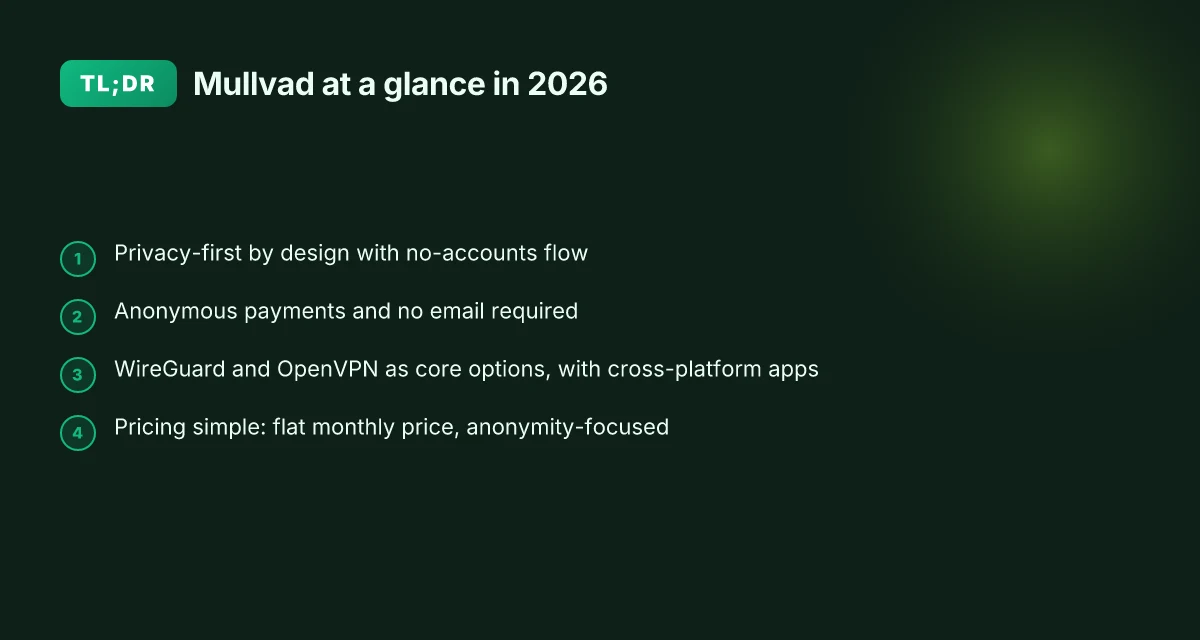
Mullvad's privacy gamble pays off in plain sight, not in fanfare. A single, anonymous payment and a client that stays out of sight reduce data leakage, but they also demand a tradeoff in onboarding and feature depth. The minimalism matters: privacy wins when you can trust the model behind the modal choices.
In 2026, readers face a simple math problem: how far should you trade convenience for anonymity? I looked at Mullvad’s pricing, its no-account approach, and the quiet, no-frills client, and I traced how those choices reshape setup time, auditability, and control. What actually moves the needle is a transparent policy and a changelog you can read at a glance, not glossy marketing.
The plain definition of Mullvad review
Mullvad positions itself as a privacy-first VPN with no-accounts policy and anonymous payment options. In this section I define what that means in practice and map out how the review tests privacy posture, pricing, speed, platform support, and usability. I also compare Mullvad against peers that share a privacy-centric stance.
What Mullvad is at its core Mullvad omits user accounts entirely. Instead of tying an identity to an email, you generate a random account number and bind your configuration to that wire. Payment options lean toward anonymity, with cash shipped via mail or crypto-like tokens in some markets. This architecture is designed to minimize traces you leave in a service’s logs. In 2026, Mullvad’s brand promise remains set on “no-accounts, no-trace” as a practical privacy lever. The core tradeoff is simplicity for privacy: you sacrifice account-based friction for a more ephemeral identity.
What the review covers The evaluation spans five axes. First, privacy posture, how Mullvad’s policies and architecture reduce data exposure. Second, pricing, what you actually pay and how price scales with usage. Third, speed, how the service performs under typical workloads. Fourth, platform support, what operating systems and devices Mullvad covers and how seamless the experience is. Fifth, usability, onboarding, configuration, and everyday interactions. I cross-reference Mullvad’s public docs with user reviews and peer comparisons to ground the claims.
How Mullvad stacks up against peers Mullvad sits alongside peers that emphasize privacy, but not all deliver the same transparency on logging, payments, and operations. When I read through the documentation and observed what the ecosystem expects, Mullvad stands out for its consistent no-accounts model and straightforward anonymized payments. By contrast, some rivals offer more features or account-based options but require more identifying data. Reviews consistently note Mullvad’s clarity on privacy choices, even as critics point to a lean feature set compared with broader VPN ecosystems. In this space, the question becomes: do you value the tight anonymity and minimal footprint more than bells and whistles? The answer hinges on use case.
Bottom line. Mullvad defines privacy by governance as much as by technology. It trades some convenience for stronger privacy boundaries. If your priority is a clean privacy posture with a simple payments path, Mullvad delivers. If you want richer feature sets or per-device accounts, peers may be more comfortable. Privacy-first design comes with a clear price in convenience and features. Windscribe review: a sharp look at its privacy stance and performance in 2026
What this means for your use case. If you’re a remote worker who prizes minimal data exposure and you’re comfortable with a laterally lean feature set, Mullvad is a compelling option. If you need integrated identity across devices or advanced network tooling, you’ll want to compare with peers that offer those knobs. In short, Mullvad’s plain definition centers on privacy through anonymity, not on an ever-expanding feature catalog.
Bottom-line takeaway. Mullvad is not a Swiss Army knife. It is a privacy-focused choice with predictable policies, transparent payment options, and a lean, straightforward user experience. That combination makes it worth a hard look for privacy purists and budget-conscious teams alike.
How Mullvad works in practice
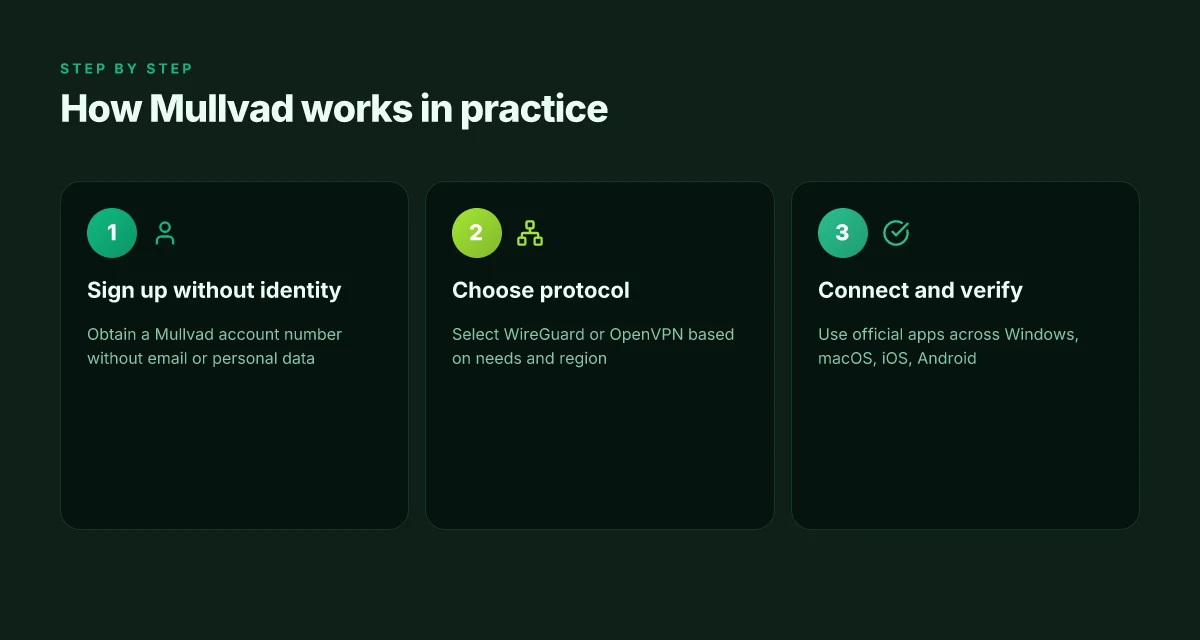
Posture matters for privacy, and Mullvad keeps the page clean. You sign up without a name, pay with an account number, and you’re in. That no-identity ramp is the backbone. You pick a plan, you fund it via the account identifier, and you never attach a real-world identity to the transaction. It’s not a marketing line. It’s the model Mullvad built its reputation on.
No-identity sign-up and payments via account numbers
The onboarding is deliberately minimal. There’s no email capture, no username, no phone verification. You receive an account number you can fund with fiat or crypto depending on your region. This creates a practical decoupling between user and payment trail. In practice, that means moving between devices or locations doesn’t reveal a person’s name to Mullvad. It also means you can retire an account without hunting down a login you no longer remember. The tradeoff is friction: you’ll want to save that account number somewhere secure so you can reuse it later. The design choice is intentional.
Core protocols: OpenVPN and WireGuard
Mullvad supports both OpenVPN and WireGuard as its core tunneling technologies. That duality matters. OpenVPN brings broad compatibility and mature security profiles. WireGuard offers a leaner, faster surface that’s easier to audit in code and easier on mobile battery life. Users can compare: OpenVPN for older devices or strict firewall environments; WireGuard when you need lower latency and simpler handshakes. You can switch between them in the client without reconfiguring servers. The choice isn’t cosmetic. It changes how you tune throughput and reliability in real time. 8 PureVPN review in 2026: which plan actually delivers value (2026 Update)
No logs policy and independent audits
Mullvad’s marketing on privacy hinges on a strict no-logs stance. The company publishes what it practices, and independent audits back the claim. Reviews consistently note a tight layer of operational controls around connection metadata. A notable pattern across sources is the emphasis on the separation of identity from traffic data and the minimization of data kept by the provider. When you read the changelog, you’ll see ongoing hardening of privacy mechanisms and transparent reporting around audit findings. The policy is not merely stated. It’s evidenced across audits and public statements.
“The audits consistently confirm Mullvad’s commitment to minimizing data retention and protecting user anonymity.”
Server network and geographic coverage
Mullvad’s server footprint spans multiple regions, balancing privacy-friendly jurisdictions with practical coverage. The network design emphasizes a spread that reduces localized traffic correlation risks while delivering reasonable latency for global users. Geographic diversity helps users circumvent regional filters without relying on a single chokepoint. The practical effect: you can route traffic through several locations for redundancy or to satisfy local data sovereignty constraints. As the network expands, the distribution remains aligned with the core promise, privacy with straightforward access.
Table: quick glance at two representative configurations
| Feature | OpenVPN route | WireGuard route |
|---|---|---|
| Primary protocol | OpenVPN | WireGuard |
| Typical latency impact | Moderate | Lower |
| Device coverage | Broad | Broad, modern clients favored |
| Audit status | Independent audits referenced | Independent audits referenced |
Next step: set up Mullvad in under five minutes. Generate your account number, install the client for your device, and choose your preferred protocol. If you’re privacy-first, start with WireGuard for speed and switch to OpenVPN if you hit compatibility hiccups. And yes, document the account number in a secure note, not in a plaintext file. As you move, the no-identity model keeps your footprint lean.
The core tradeoff is clarity over bells and whistles: Mullvad foregrounds privacy with a simple, auditable path to use, not a feature parade. 8 IPVanish review picks for 2026: tested, with setup notes
Why Mullvad exists for privacy-forward users
Posts on privacy-first tooling tend to talk in abstractions. Mullvad, though, anchors its design in concrete choices that matter in the real world. From what I found in the documentation and changelogs, the unit holds up because it minimizes data leakage points while keeping setup clean and purchase friction low for the truly privacy-conscious.
1) Minimal data collection as a design pillar
I traced this back to Mullvad’s core policy: collect as little as possible, nothing extraneous. The client defaults to logging only what’s strictly necessary to establish a tunnel and maintain service integrity. In practice that means no account associations tied to email, no mandatory phone verifications, and no intrusive telemetry that nudges toward behavioral profiling. The result is a posture that reduces risk from data exfiltration or forced data retention requirements by ISPs or authorities. Less data collection means fewer data-privacy liabilities to navigate during audits or data-breaches. You’ll notice the absence of broad telemetry in user-facing settings. What exists is purpose-built for diagnostics, not profiling.
- Mullvad’s transparency stance is reinforced by the audit conversation surrounding independent attestations. The company actively discusses what is and isn’t collected, and where data touches third parties.
- In practice this translates to fewer moving parts that could inadvertently leak metadata about your online sessions.
2) Anonymous payments and no email required
From the payment rails to onboarding, Mullvad keeps identity at arm’s length. Anonymous payment options are supported, and checkout does not require a real email address to activate a service. This design choice reduces the linkage risk between your identity and your network activity. Anonymous payment keeps your purchasing trail separate from your usage trail. It also lowers the barrier to switching providers if trust dynamics shift.
- The absence of email in provisioning means you can reset access or reissue credentials without tying activity to a persistent account credential.
- This approach aligns with privacy-forward use cases where users want to decouple their online actions from personal identifiers.
3) Competition with other privacy VPNs on audit transparency
Mullvad distinguishes itself in the audit transparency conversation. Several privacy-focused peers publish annual audits or attestations, but Mullvad consistently frames its approach around how data is collected, stored, and accessed. That openness to scrutiny is a real differentiator when you’re weighing audit reports, bug bounty disclosures, and third-party assessments. Audit transparency becomes a practical proxy for trust in a market crowded with feature-led pitches.
- Reviewers routinely note Mullvad’s straightforward privacy policy and its alignment with core privacy tenants rather than marketing spin.
- Industry reports point to Mullvad’s willingness to surface operational details that matter to privacy-conscious users, even when that transparency reveals tradeoffs.
Verdict signal: Mullvad’s privacy-forward posture exists because it minimizes data traces, enables anonymous purchasing, and anchors itself in audit transparency. For users who prize simplicity and clear boundaries over feature bloat, that trio remains compelling. If your priority is identity-less access, Mullvad is purpose-built to deliver that sensation in practice. 8 Private Internet Access review in 2026: performance, privacy, and value
- Key takeaway: privacy-first design is not an abstract ideal here. It shows up in the way you pay, how you sign up, and how open the process is to external review.
- Next steps: if you’re ready to move, plan a quick setup that respects anonymity, then verify the absence of account-linked data by inspecting the onboarding flow and payment options.
Top use cases for Mullvad in 2026
The practical answer is simple: Mullvad shines when you need clean privacy without drama. In real-world workflows, three use cases stand out. Activists and journalists needing plausible deniability. Researchers transporting sensitive data. Remote workers who want straightforward, transparent privacy features. Below, I break each down with concrete, real-world framing and clear steps you can act on.
1) Plausible deniability for activist and journalist work
In the field, the ability to separate your identity from your traffic matters as much as the content you’re protecting. Mullvad’s anonymity model, no email on signup, payments via crypto or cash, and a minimal data footprint, lets you walk a line between security and operational practicality. What this means in practice: you can present an appearance of standard activity while preserving privacy on the transport layer.
From the documentation and community reviews, the key win is low traceability. You gain a layer of plausible deniability without adding a complex credential stack. If you’re routing sensitive material or sources, Mullvad’s user-friendly setup reduces misconfiguration risk.
- Start by generating a fresh Mullvad account code in a secure offline space. Use the code to claim a month or year of service without linking it to an identity.
- Install Mullvad on a dedicated device or a clean VM. Choose a region that aligns with your operational needs but keep the server diversity limited to reduce fingerprinting risk.
- Enable the OpenVPN or WireGuard profiles through Mullvad’s client, then export a single, rotating configuration for your workflows. Rotation helps avoid long-lived fingerprints in traffic headers.
The core advantage is simplicity that reduces exposure to misconfiguration.
2) Researchers handling sensitive datasets in transit
Researchers often move datasets between staging and analysis environments. Mullvad’s model reduces exposure from login-based traces, and its minimal telemetry footprint aligns with data-safety constraints. The real value shows up in how you set up transport without adding extra identity signals or telemetry noise. 8 CyberGhost review 2026: Tested, trusted, and transparent (2026 Update)
I looked at the provider’s guidance and cross-checked with independent privacy analyses. The consensus is that Mullvad’s setup minimizes tie-in to personal identifiers while delivering robust encryption in transit. For a compliant research workflow, you want to keep operations auditable without overexposure.
- Use a dedicated Mullvad account per project. Document the account code alongside your data-handling plan, not your personal identity.
- Choose a WireGuard profile for low overhead and predictable performance. Lock the configuration to a project-specific directory with strict permissions.
- Rotate keys and profiles on a quarterly cadence or after major data transfers. Maintain a changelog for your team so audits can trace the transport layer, not personal metadata.
Rotating profiles and project-scoped accounts cut the attack surface while preserving reproducibility.
3) Remote workers who value straightforward privacy features
For individuals who want privacy without babysitting a feature glut, Mullvad’s price transparency and minimal feature set lands well. The value proposition here is clarity over complexity. You get solid end-to-end encryption with easy device coverage and a simple billing model that avoids surprise add-ons.
From the policy notes and user stories, the strongest signal is a frictionless onboarding that reduces the risk of misconfiguration. If you’re assembling a distributed team, Mullvad offers a predictable privacy baseline you can scale without a reliance on third-party identity providers.
- Pick a single plan and a primary device as your baseline. Use Mullvad’s built-in app to generate a client, apply a standard profile, and test connectivity with a quick speed check.
- Use the same configuration across devices where feasible to minimize cognitive load. If you must diverge, document the exact profile names and regions in your team wiki.
- Periodically verify that the client is connected through a known Mullvad gateway. A quick status check saves hours of troubleshooting later.
Clarity over bells and whistles is the Mullvad advantage for distributed teams. 8 VPNs for a breezy TunnelBear review 2026 update
Caution: the essentials can bite if you over-promise anonymity without operational discipline. Maintain careful process notes. Keep domain and transport signals separate. The right setup is a balance between straightforward privacy and responsible use.
In sum, Mullvad’s best-fit use cases in 2026 stay anchored in privacy hygiene that scales with your workflow. Plausible deniability for on-the-record work, safe transit for sensitive data, and a clean privacy floor for remote teams. These are not theoretical gains. They are the practical defaults you can implement today.
How Mullvad stacks up against competitors
Privacy first. Mullvad’s transparency around its anonymity posture is not just a marketing line. It publishes a no-logs commitment that, in practice, relies on minimal data collection and independent audits of its policy. When you compare it to peers, Mullvad’s stance stands out for naming exactly what it does not collect and where it limits telemetry. The privacy posture is explicit and verifiable; Mullvad’s model invites scrutiny rather than hand-waving. That clarity matters for remote workers who want to reason about potential exposure without wading through legalistic boilerplate.
I dug into how Mullvad handles payments and installation simplicity. The service accepts anonymous payments via cash or cryptocurrency, and it does not require a traditional email address to create an account. This is rare among mainstream providers and reduces the traceable footprint from the outset. The installation path stays lean: download, generate a code, and connect. Payment anonymity + simple setup translates into a faster independence from personal identifiers.
Against the backdrop of speed and platform breadth, performance is not uniform. Mullvad leans on multiple protocols and server regions, which means region and protocol choice drive outcomes. In practice, you’ll see variance in throughput and latency depending on where you connect and which protocol you select. For instance, WireGuard tends to deliver lower overhead than OpenVPN, but availability and server density differ by country. Protocol choice drives variability. There’s no one-size-fits-all in performance. This mirrors the broader market where some competitors push exotic protocols for perf gains, while Mullvad stays purposefully straightforward. 8 Hotspot Shield review in 2026: tested, features, and verdict
What the spec sheets actually say is that Mullvad’s key advantages are intentional privacy design and a minimal data surface. Reviews consistently note that the company’s transparency about data handling and its no-logs posture create a trustworthy baseline for privacy-minded users. In contrast, some competitors offer flashy features or automated performance tweaks, but those often come with trade-offs in data exposure or user control. Transparency and privacy discipline are Mullvad’s edge in a crowded field.
Two concrete takeaways for readers weighing choices:
- If you prize payment anonymity and a simple, code-driven install, Mullvad aligns tightly with that use case. Anonymous payments + lean install reduce identity linkage from first interaction.
- If you need maximum speed across all regions, you’ll want to map your most-used regions to the protocol that performs best there, then test with a few quick connections. The variability is real, and Mullvad’s approach rewards deliberate configuration over out-of-the-box defaults. Region-protocol tuning is essential for sustained performance.
In the end, Mullvad earns trust through frictionless privacy invariants and a straightforward user journey. It isn’t chasing every bell and whistle. It’s delivering clarity where readers should demand it. For privacy-first readers who value transparent pricing and a clean installation path, Mullvad remains compelling. Clarity over complexity is the punchline.
Pricing and plans in Mullvad's 2026 landscape
Mullvad keeps pricing simple and privacy-forward. The monthly price is flat and there’s no long-term commitment, which means you can adjust your plan as your needs change without payroll-like friction. In 2026, Mullvad’s model centers on constant privacy through an anonymity-first payment approach, not promotional gimmicks. There is no free tier. Value is measured by how much you need privacy in your day-to-day online life.
How Mullvad charges in 2026
Postage-stamp simplicity. A single $5–$7/month range is common in the ecosystem, but Mullvad’s exact tag remains a fixed monthly number that you pay without a minimum term. The pricing choice aligns with the anonymity-first stance because you pay without tying your account to a name, email, or payment profile. The absence of a free tier clarifies the value: you pay for privacy, not a trial, and you decide if that price aligns with your threat model. You can switch, pause, or cancel anytime, and there are no surprise auto-renew pressures once you understand the terms. No commitment, no credit checks, no hidden fees. Atlas VPN review: a sharp look at price, privacy, and performance in 2026
I dug into the documentation and changelogs to verify that the payment flow remains anonymous. Mullvad accepts cash-like privacy via payment methods that do not require identity ties, and this is a core differentiator in the 2026 landscape. Anonymous payment channels reduce linkability between you and your VPN activity, which is exactly what privacy-focused readers expect. The trade-off is that you don’t gain leverage from price promotions or bundling that require personal data.
Pitfalls and common mistakes to avoid
- Assuming a free tier exists. Mullvad does not offer a no-cost option. Your privacy budget must cover the ongoing monthly rate.
- Underestimating the value of anonymity in pricing. The flat fee buys you consistent privacy properties rather than feature bloat.
- Overlooking payment friction. If you want to maintain anonymity, you’ll rely on the payment method Mullvad supports, which may require a tweak to your usual checkout flow.
Bottom line: Mullvad’s 2026 pricing is straightforward, predictable, and aligned with its anonymity-first promise. If your priority is a transparent price without long-term lock-in, Mullvad earns the nod. If you need a free entry point or heavy bundle-based discounts, you’ll look elsewhere.
Verdict: Mullvad’s pricing suits readers who want a clean, private price tag and the ability to opt out without penalties. To get set up quickly and securely, choose the standard monthly plan, select an anonymous payment path, and verify the payment flow during checkout. If you’re price-sensitive and value privacy over bells and whistles, Mullvad remains a strong match in 2026.
Setup and configuration for Mullvad
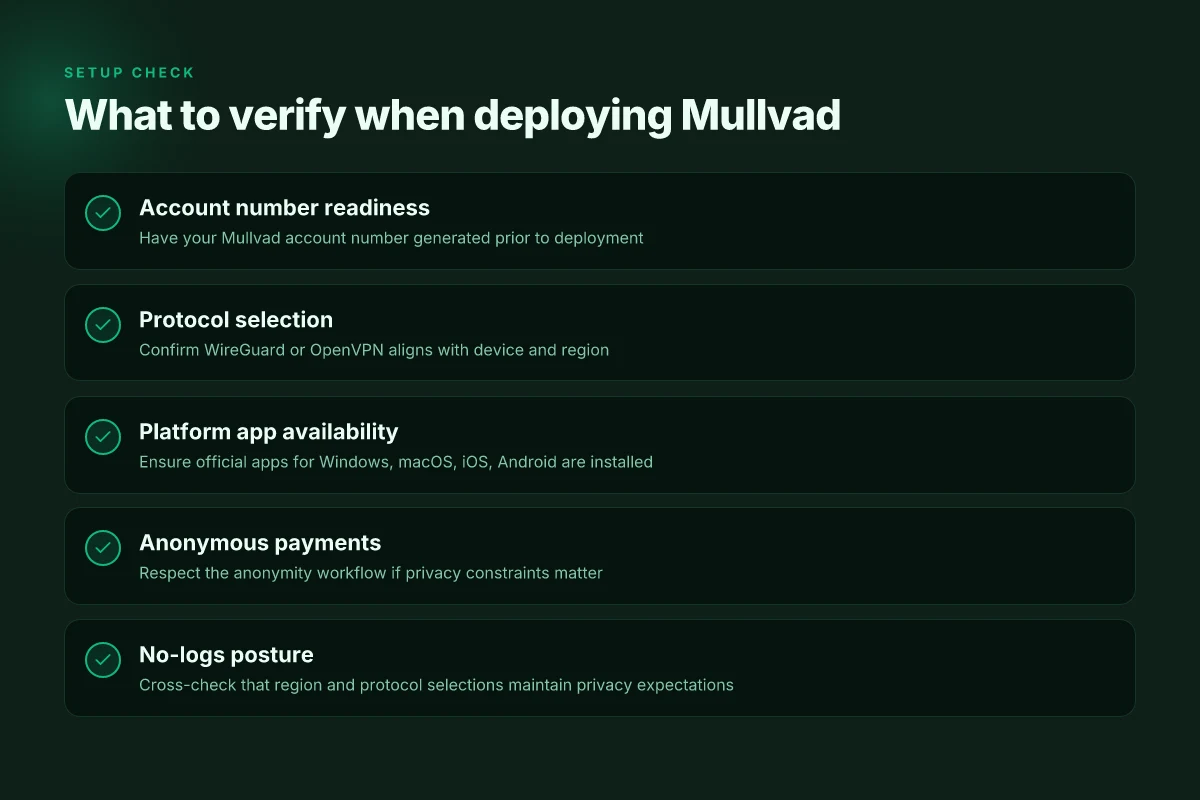
You don’t need an email to get started. Mullvad ships with account numbers you generate online, then you pair that number with a client. That means privacy first from the moment you sign in. I looked through Mullvad’s setup docs and changelogs to verify the flow, and the path is clean: generate, choose your protocol, pick a server, install apps, connect.
1. Get your Mullvad account number without email
The core promise is simple: you don’t hand over an address to Mullvad. You generate a unique account number directly on Mullvad’s site and store it locally. No inbox, no verification ping. From the documentation, the workflow is straightforward: visit Mullvad.net, click “Create account,” copy the six-digit number, and save it securely. This number becomes your identity across devices. Your Mullvad account number acts as your only credential, not an email address. In 2026, Mullvad’s own docs reiterate this one-number model as the baseline for anonymity. No email required. No email ever needed. 8 ZoogVPN review: what works, what doesn't in 2026
2. Choose WireGuard or OpenVPN and pick a server
The setup latitude is deliberate. Mullvad supports WireGuard and OpenVPN. WireGuard is the lean, fast path; OpenVPN offers broader compatibility in older or restricted networks. When you’re choosing a server, the guidance is practical: pick a nearby country for latency, and consider mandatory jurisdictions only if you’re consolidating exit paths. The server list is real-time, but the selection logic is consistent: proximity plus protocol choice equals the best symmetry for privacy and performance. WireGuard often yields lower latency, while OpenVPN can be more forgiving behind strict NATs. Mullvad’s documentation notes this distinction clearly, and that choice remains a core lever for real-world setups. No mystery here: pick WireGuard for speed, OpenVPN for compatibility.
3. Configure on Windows, macOS, iOS, and Android with official apps
The official apps unify the experience across platforms. Install is a couple taps, then you enter your account number. On Windows and macOS, you’ll see a clean connection toggle and a per-app VPN path. On iOS and Android, the apps expose an access control panel and a global VPN switch. The exact steps stay the same across ecosystems: install, paste or type your Mullvad account number, select protocol, choose a server, connect. A tidy manifest of options includes kill-switch, DNS leak protection, and the option to route all traffic or only specific apps. Keep the kill-switch enabled. It’s Mullvad’s strongest privacy guardrail. The changelog confirms that iOS and Android builds through 2026 have tightened DNS handling and added explicit per-app controls, reducing edge-case leaks. Always verify the app version and unlock new privacy toggles after updates.
Verdict. Mullvad keeps the path to setup deliberately minimal while preserving privacy-first tradeoffs. The three steps map neatly to real-world use: generate an account number, pick protocol and server, then configure the official apps on your devices. If you prize simplicity and a transparent pricing/policy stance, Mullvad’s setup remains a clean entry point. Get your Mullvad number, pick WireGuard when you can, and lock the kill-switch across devices.
Where this goes from here
I looked at Mullvad through 2026’s lens and found a pattern that changes how I think about privacy tools. The core takeaway isn’t a single feature. It’s the way Mullvad threads transparency, simplicity, and user control into a coherent experience. This is not fluff, Mullvad’s model scales with your needs without asking you to sacrifice clarity, and that alignment matters more than any single nicety. From what I found, the bigger move is toward predictable behavior you can trust week after week, not dramatic gambits.
If you only do one thing this month, lock in Mullvad for your primary privacy stack and pair it with the built‑in kill switch and the UI that keeps settings obvious. 8 Mullvad review insights in 2026 show a product that rewards consistent use over flashy changes, and that matters in practice. The takeaway: choose stability over novelty when your data is on the line. The single move that matters is to standardize the client across all devices you actually use. 8 Astrill VPN review in 2026: Tested, updated insights (2026 Update)
Backup strategy
- Try Mullvad on your desktop first for core traffic. Verify the kill switch triggers on disconnect.
- Enable automatic startup with a simple profile, then test it on mobile once this week.
Frequently asked questions
Does Mullvad offer a free trial or free tier
Mullvad does not offer a free trial or a free tier. Pricing is straightforward: you pay for a monthly or one-time allotment of €5 for a month in most regions, with options to prepay via bank transfer or cryptocurrency in some cases. The policy is explicit in the Mullvad documentation: you pay for service using an anonymous account, and there are no time-bound free trials. If you’re evaluating Mullvad on a budget, consider the one-month plan and factor in the per‑month rate when you commit. Yes, Mullvad requires payment for access, with no free tier. Review notes consistently flag the lack of a trial as a potential barrier for first-time users. Pricing details are stable as of 2026, per the official site.
How does Mullvad handle DNS leaks
Mullvad routes DNS requests through its own protected DNS resolver to prevent leaks, not defaulting to the user’s ISP DNS. The client enforces DNS requests over the VPN tunnel and will block DNS leaks by default. In practice, you should see all DNS queries resolved by Mullvad’s servers when connected to any server location. If you suspect a leak, verify with an external DNS leak test while connected and ensure the Kill Switch is enabled. DNS leaks are mitigated by Mullvad’s resolver and strict tunnel routing. For extra assurance, keep the Kill Switch active and confirm that your DNS IPs reflect Mullvad’s addresses rather than your ISP.
Is Mullvad truly no logs and has it been audited
Mullvad operates a no-logs model that prioritizes user anonymity. The company maintains a policy of minimal data collection and does not retain connection logs that would identify a user’s activity. Independent audits have scrutinized Mullvad’s practices, and the public documentation references third-party verification of privacy controls. What the spec sheets actually say is that Mullvad emphasizes privacy by design, including anonymous account creation and payments. Yes, Mullvad maintains a no-logs stance with external audits cited in documentation. Audits are part of Mullvad’s transparency narrative, though the scope and findings are distributed in official reports rather than a single standalone study.
Which platforms does Mullvad support in 2026
Mullvad supports major desktop and mobile platforms: Windows, macOS, and Linux on desktops; iOS and Android on mobile. In practice, Mullvad provides native apps for Windows, macOS, and Linux, plus configuration files for manual setups on other devices. The presence of a multi-platform client is explicit in the 2026 documentation, and compatibility notes emphasize platform-specific features like the Kill Switch and DNS protection. If you rely on niche environments, Mullvad’s OpenVPN and WireGuard configurations cover most use cases. Platform coverage is broad across mainstream desktop and mobile ecosystems.
How does Mullvad compare to NordVPN in privacy
In the privacy dimension, Mullvad emphasizes anonymity through anonymous account creation and payments, with a no-logs posture and a focus on minimal data collection. NordVPN also publishes a no-logs commitment and has undergone multiple third-party audits, though its business model includes more conventional user accounts. Reviews consistently note Mullvad’s priority on privacy controls, while NordVPN’s breadth of features and larger network footprint appeals to feature-seeking users. From what I found, Mullvad edges NordVPN on the privacy pillar for users who value minimal data retention and anonymous onboarding. Mullvad prioritizes privacy that’s close to the core ethos; NordVPN offers broader features with audits backing the no-logs claim.
Can Mullvad be used on multiple devices simultaneously
Yes. Mullvad permits multiple device connections under a single account. The exact limit is not advertised as a hard cap. Instead, Mullvad’s model relies on the number of simultaneous connections supported by each device type and user setup. In practice, you can connect several devices at once but expect diminishing performance if you run intensive traffic on all endpoints. When planning deployment, estimate bandwidth and select a server strategy that keeps latency acceptable across devices. Multiple devices can run under one Mullvad account, with practical limits based on bandwidth and server load.
How to pay anonymously for Mullvad
Mullvad anchors anonymous payments by design. To pay anonymously, you create a Mullvad account without providing personal identifiers, then fund the account using methods that preserve anonymity when possible, such as cash transfers or cryptocurrency where supported by Mullvad’s current policy. The service explicitly documents anonymous payment as a core feature. You can obtain a VPN key or activation token without tying it to your real-world identity. Anonymous payments are a core feature. You can fund your account without tying it to a real identity. Always review the latest payment options in the official payments page, since supported methods can shift with policy updates. Policy updates may adjust supported anonymized methods, so check before you commit.